
Enabling this setting confirms your approval for cookie implementations throughout the Han’s Laser website, together with the transfer of your personal data to third countries. You may withdraw this authorisation via this interface at any time. Kindly note that all data processing undertaken pursuant to this consent shall remain legally valid prior to your withdrawal.


As AI computing power surges and evolves toward higher-order capabilities, per-rack power density continues to rise, and server power consumption climbs rapidly. Conventional UPS (Uninterruptible Power Supply) architectures can no longer satisfy the stringent demands of high-density, highly dynamic load applications. The BBU (Battery Backup Unit) has transitioned from an optional backup accessory to a mandatory standard configuration for high-density AI data center racks, serving as the last line of defense for GPU stable operation and data integrity. In high-end intelligent computing, the importance of the BBU continues to increase, with market demand rising exponentially.
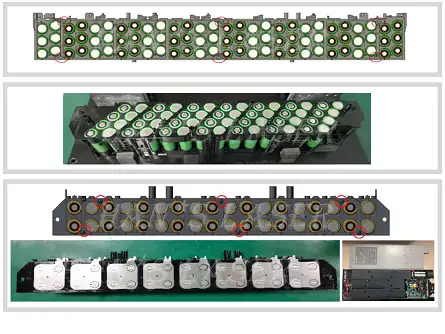
BBUs predominantly adopt 18650/21700 series full-tab small cylindrical cells, enabling rapid response during power spikes and providing additional time for data preservation during outages—directly impacting the power supply safety and operational stability of AI servers. Compared with conventional single-tab or dual-tab designs, full-tab configurations offer shorter conductive paths, lower internal resistance, and more uniform temperature rise. However, they impose more stringent requirements on tab forming, welding, internal resistance control, power output, consistency, temperature rise, and safety.

Laser Welding for AI Server Battery Backup Units (BBU)
Battery welding is a critical foundation for ensuring the safety, reliability, and performance stability of battery modules. Han’s Laser provides a full-process, integrated intelligent manufacturing line for server battery production, integrating intelligent control, inline inspection, and performance testing. Through precise control of welding parameters, the line ensures joint strength and consistency, addressing the common pain points of semi-automatic production lines—cumbersome changeover procedures, long changeover cycles, difficult process data traceability, and poor welding consistency—and enabling full-process battery pack mass production from cell loading to finished pack unloading, fortifying the power foundation for AI computing.
Automated Laser Welding and Assembly Line for Server Power Supplies
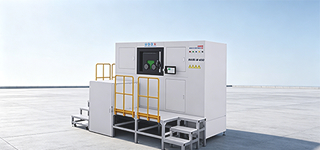
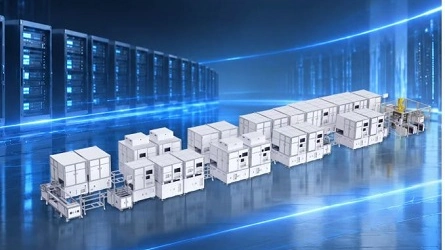
Developed by Han's Laser specifically to address the pressing power requirements of next-generation AI data centers, the automated laser welding and assembly line for server power supplies accommodates a variety of welding materials and is primarily applied to the processing of 18650/21700 series cylindrical cells and server BBU battery pack applications.
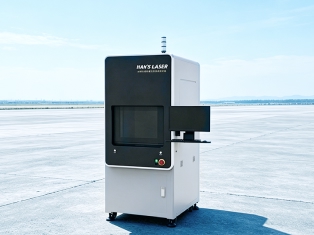
The system features a rectangular closed-loop layout, modular flexible architecture, galvanometer laser precision welding, and full-link inline inspection, creating a one-stop fully automated intelligent manufacturing platform that balances production capacity, quality controllability, and operational convenience, providing stable and reliable hardware and data support for high-quality battery pack mass production.
Full-process closed-loop manufacturing: From Cell to Finished Pack in One Station
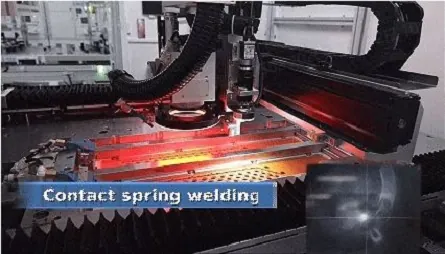
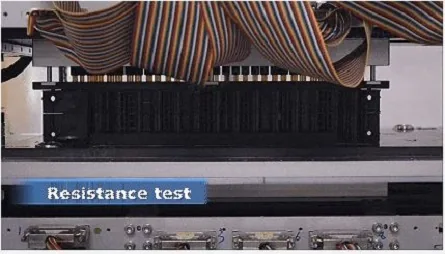
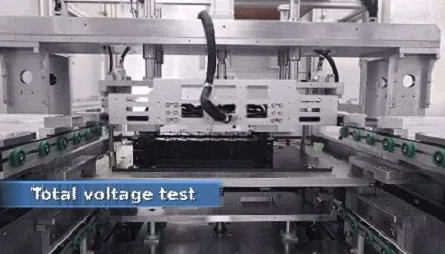
With a PLC as the core control hub, the system integrates a bracket loading machine, cell sorting machine, bracket insertion machine, screw-driving machine, balancing test machine, contact spring loading machine, laser welding machine, CCD inspection machine, Flipping Machine, impedance/total voltage test machine, and unloader. It delivers a one-stop, customizable, fully automated welding, inspection, and assembly solution for BBU batteries from cell to pack, achieving full-process, full-flow data traceability.

High-Flexibility Modular Architecture: Flexible Scheduling of Production Capacity and Maintenance
The system adopts a modular design, allowing process units to be added or removed as needed and UPH capacity to be freely adjusted. A 30-minute rapid changeover capability accommodates production switching across multiple server battery pack specifications, substantially reducing changeover waiting time. After assembly, battery packs are automatically transferred by AGV to the next process.
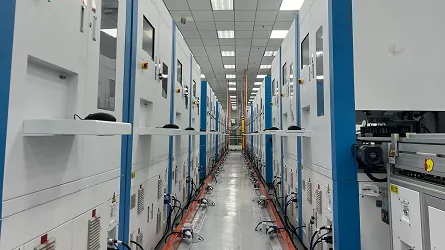
The innovative rectangular closed-loop layout shortens the line’s footprint, with dedicated maintenance access reserved inside the loop to provide ample workspace for maintenance. Each machine supports offline maintenance, so fault maintenance does not affect full-line operations, maximizing equipment availability.

CCD Vision + Electrical Performance Testing: Safeguarding the Power Quality Baseline
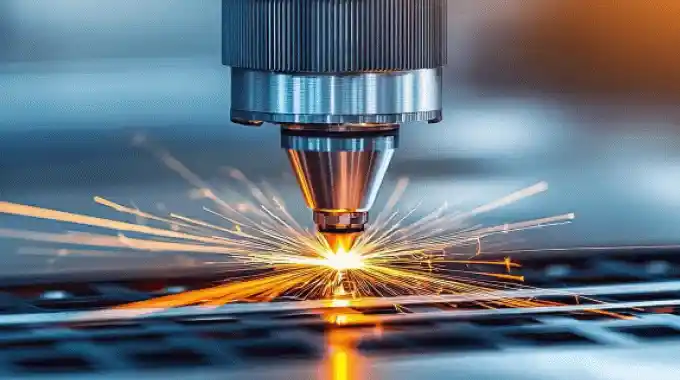
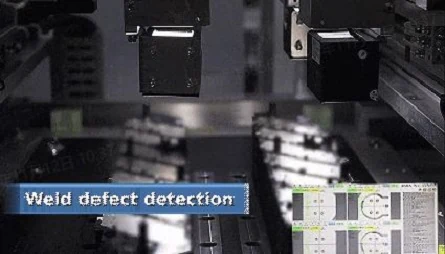
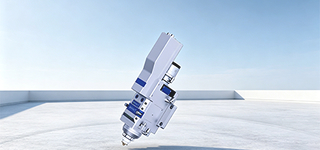
Galvanometer laser welding enables high-precision dynamic welding of the tab region, with energy output stability within ±1%, a stable welding process, and precisely controllable heat-affected zones, avoiding damage to the internal cell structure. CCD vision adopts AI algorithms to detect and identify micron-level defects such as cold welds, offset welds, and burn-through. Dual electrical verification—impedance and total voltage—further rejects defective units. All inspection stations automatically divert NG defective products, preventing them from entering downstream processes at the source.


Laser Welding Enabling High-Precision Connections
As 800V high-voltage power architectures gain broader adoption in AI computing, the BBU is evolving from an in-rack embedded module to an external high-voltage energy storage unit. The number of cells connected in series is increasing from tens to hundreds, exponentially raising the difficulties of BMS balancing, insulation, thermal management, and safety management.
Through full-process closed-loop manufacturing, full-process data traceability, high-flexibility architecture configuration, and multi-dimensional inspection control, Han’s Laser stably reproduces critical processes and parameters via standardized, automated workflows, ensuring BBU mass production quality and quality consistency. This safeguards short-duration high-power output and long-term stability for server racks, providing critical process support and core hardware for AI data center power supply upgrades.