In high-end manufacturing sectors such as new energy, electrical equipment, precision motors, and 5G communications, copper has become a core base material for conductive busbars, heat conduction, and circuit connections, owing to its ultra-high electrical conductivity, excellent thermal conductivity, and good ductility. For a long time, however, copper welding has been widely recognized as one of the most technically demanding challenges in the field. Challenges such as high reflectivity, susceptibility to spatter, porosity, and uneven penetration depth have severely constrained product yield and performance improvement.
Conventional processes—including traditional laser welding, TIG welding, and resistance welding—can no longer meet the precision production requirements of high-end copper components. The adoption of ring spot lasers, however, has fundamentally broken through the technical bottlenecks of copper welding and emerged as the core solution for precision welding of highly-reflective materials.
Copper Welding Challenges
Copper is a typical highly-reflective, high-thermal-conductivity metal. These material characteristics cause conventional welding processes to “fail repeatedly,” with pain points concentrated in four aspects:
1. Extremely low laser absorptivity, difficult weld initiation
Traditional lasers require ultra-high power to initiate the arc, resulting in high energy consumption, frequent arc interruptions, insufficient penetration depth, and false or missed welds.
2. Excessively fast heat conduction, poor molten pool stability
Shallow penetration depth, inconsistent bead width, and rough bead formation are common, failing to meet the welding requirements of precision components.
3. Frequent spatter and porosity defects, low yield
The unstable keyhole and violent molten pool agitation associated with conventional single-spot lasers readily generate substantial spatter and porosity, weakening the mechanical and electrical properties of the weld.
4. Large heat-affected zone, degradation of base material properties
High temperatures cause oxidation, softening, deformation, and cracking of copper, impairing its inherent electrical and thermal conductivity and making it difficult to satisfy high-end applications such as power batteries and precision motors.
A Dedicated Solution for Welding Highly-Reflective Materials
Unlike conventional single Gaussian spot lasers, the ring spot laser adopts an independently controllable dual-beam structure comprising a central high-brightness solid spot and a peripheral ring spot. The power, spot size, and energy ratio of the two beams are all independently adjustable, precisely matching the welding characteristics of highly-reflective materials such as copper.
Core Working Principles
1. Central beam:
With high energy density, high brightness, and strong focusing capability, it rapidly penetrates the highly reflective surface of copper, instantly forming a stable keyhole to achieve deep-penetration welding. This addresses the core issues of difficult weld initiation and insufficient penetration depth in copper.
2. Ring beam:
Providing wide-area uniform heat input, it envelops the central molten pool, effectively enlarging the keyhole opening, stabilizing molten pool flow, and slowing the cooling rate of the molten pool to make the welding process more stable. Simultaneously, it preheats the base material in advance, substantially improving the laser absorptivity of copper and reducing welding defects at the source.
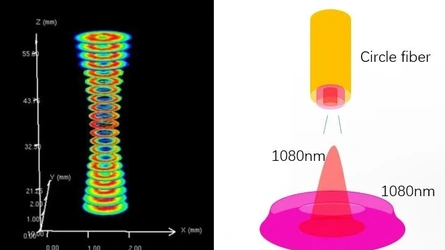
This dual-beam synergistic mode—“central keyhole drilling, outer ring pool stabilization”—perfectly resolves all the drawbacks of conventional laser welding of copper, achieving a qualitative breakthrough in precision welding of highly-reflective materials.
Core Technical Advantages of Ring Spot Laser Welding
Compared with conventional welding processes, the ring laser offers disruptive advantages in the copper welding application, comprehensively enhancing welding quality, efficiency, and stability:
1. Ultra-low spatter, exceptionally smooth bead formation
The ring beam stabilizes the keyhole and regulates molten pool flow trajectories, suppressing turbulent spatter of molten metal. After welding, the bead is flat, smooth, and free of pop-outs and burrs, eliminating the need for subsequent grinding and polishing. This makes it ideally suited for workpieces with stringent appearance and precision requirements, such as new energy busbars and terminal posts.
2. Significantly reduced porosity, excellent degassing performance
The wide-area heat input of the outer ring extends the retention time of the molten pool, providing ample space for gas to escape and effectively resolving the porosity and void issues commonly encountered in copper welding. The weld exhibits extremely high density, and the electrical conductivity, tensile strength, and fatigue resistance of the welded joint approach those of the base material, fully meeting the requirements of high-voltage, high-current operating conditions.
3. Controllable heat input, minimal workpiece deformation
With precise dual-beam energy ratio control, heat input is concentrated and uniform, and the heat-affected zone is substantially reduced, preventing overheating, oxidation, deformation, and softening of the copper base material. This is particularly suitable for welding thin-walled copper parts and precision small components, greatly improving product consistency.
4. Broad adaptability, balancing precision and high-efficiency production
By adjusting the inner/outer ring power ratio and spot size, the system can flexibly accommodate the welding requirements of ultra-thin copper foil, medium-to-thick copper plate, and profiled copper components. It supports both micron-level precision spot welding and deep-penetration continuous welding, with welding speed improved by more than 30% over conventional processes, making it suitable for large-scale mass production.
Practical Application—Copper Welding
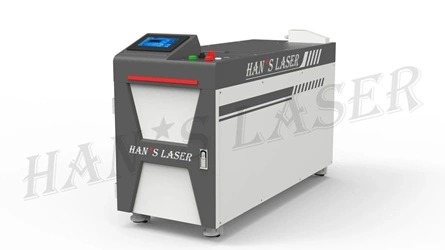
The welding capability of the HW-Q-CW6000-4-2-D/E5-H ring laser was tested on 4 mm copper plate. The welding process employed coaxial nitrogen shielding with oscillating welding technology, effectively suppressing spatter and high reflectivity.
Reducing the oscillation width enables a penetration depth of >4 mm, demonstrating the equipment’s capability to fully penetrate 4 mm copper. As the oscillation width increases, the laser energy becomes more dispersed and the penetration depth decreases accordingly.
By properly matching oscillation width and frequency, bead appearance can be optimized while ensuring penetration depth meets specifications, fully leveraging the process advantages of the 4+2 ring laser in thick copper plate welding.
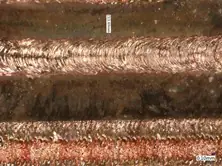
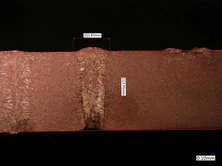
1.8 mm bead width, 4 mm copper fully penetrated
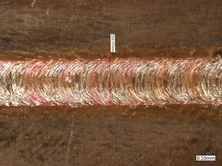
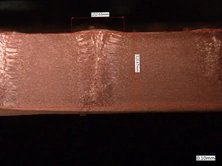
2.6 mm weld width, penetration depth up to 3.67 mm
Empowering the Entire High-End Manufacturing Value Chain
With its superior welding performance, the ring laser has become the mainstream equipment for precision copper welding, covering multiple high-end manufacturing sectors:
1. Applications in new energy power batteries
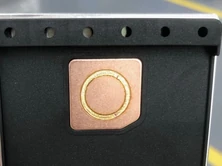
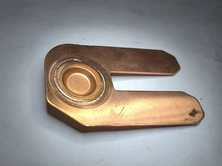
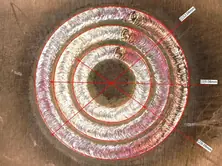
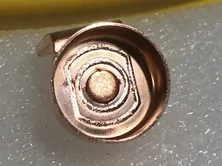
Used for welding core conductive components such as copper busbars, terminal posts, and adapter plates, it enables single-pass or multi-pass circumferential seam welding of copper terminal posts and spiral spot welding of multi-layer tabs. With few welding defects, low-porosity and spatter-free welds, and excellent electrical conductivity, it significantly enhances the operational safety of power batteries.

2. Applications in high-voltage electrical connections
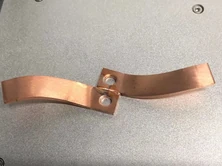
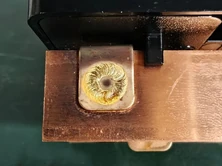
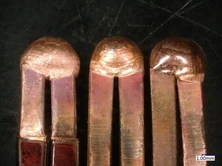
Used for welding copper components such as contactors, busbar connectors, and conductive terminals, it can perform contactor busbar splicing, multi-point busbar circumferential seam lap welding, copper rod end ball forming, and multi-pass weld seam welding of conductive terminals. The welds offer stable conductivity and robust structural integrity, ensuring long-term reliable operation of high-voltage electrical systems.
3. Applications in liquid-cooling
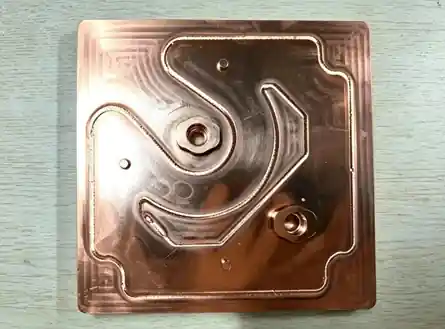
Used for precision welding of copper water-cooled heat sink plates and ultra-thin heat dissipation substrates, it can perform long-seam splicing and multi-pass lap welding of copper heat sink plates. The welds provide high strength, high conductivity, and reliable sealing, meeting the stringent standards of high-end manufacturing.
Ring Spot Laser: Opening a New Era for Copper Welding
The core contradiction in copper welding is fundamentally a mismatch between the highly-reflective, high-thermal-conductivity material characteristics and the energy input of conventional processes. Through innovative independent dual-beam control technology, the ring laser fundamentally resolves the industry pain points of excessive spatter, high porosity, poor bead formation, and unstable performance in copper welding.
As manufacturing upgrades toward precision, high efficiency, and high quality, conventional rough welding processes are being progressively phased out. Ring laser welding not only improves the yield and production efficiency of copper component welding but also safeguards the core performance of high-end equipment, making it a key enabling technology for the upgrading of the new energy and precision manufacturing industries.
In the future, as ring laser technology continues to iterate, power stability and beam control precision will be further enhanced, and its application scenarios in welding of highly-reflective materials will continue to expand, establishing it as the mainstream solution for high-end precision metal welding.