


Han's Laser has long prioritized R&D and technological innovation. We now have world-leading R&D capabilities in the laser industry and over 7,400 patents. Leveraging our unique product strengths, we are continuously expanding full-scenario solutions to empower intelligent manufacturing for various sectors worldwide.
A Sharp Edge for Precision Processing of Glass Products: Picosecond Laser
May 26, 2023
Glass is a material widely used in micro and precision machining, widely used in consumer electronics, automobiles, optical lenses, household appliances, and other fields. Nowadays, with the increasing demand for precision in glass materials in the market, it is necessary to achieve higher precision processing results. The prominent feature of glass is its hardness and brittleness. Whether it is diamond cutter, alloy cutter, or water cutter, these traditional processing techniques have some drawbacks, which cannot meet the requirements of irregular processing of glass products and control the edge quality and small cracks.
With the continuous development of picosecond laser technology, using infrared picosecond lasers for precision processing of glass has become a reliable choice.
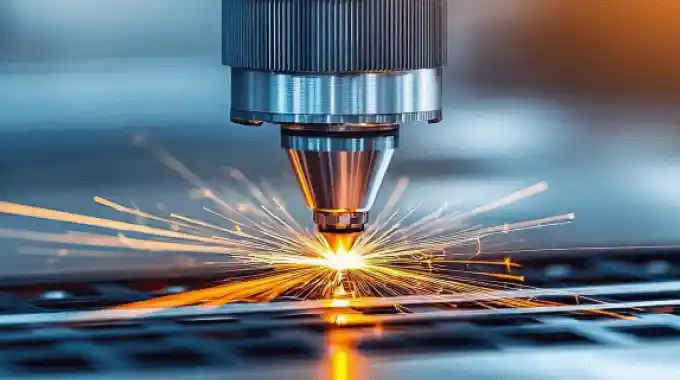
The principle of picosecond laser processing glass: When the laser is focused by the focusing head, it obtains a huge single pulse energy and a high peak power, high power density micron level beam. When the beam acts on the glass material, the center light intensity of the beam is lower than the edge, the refractive index of the material center is greater than the edge, the propagation speed of the beam center is slower than the edge, and the beam exhibits nonlinear optical Kerr effect to generate self focusing, continuing to improve power density, When a certain energy threshold is reached, electrons are released from the atomic bonds, forming a plasma.
Because the interaction time between the laser and the material is very short (pulse width<10ps), the plasma has been ablated from the glass surface before it can transfer the energy to the surrounding materials. There is almost no Heat-affected zone, no obvious small cracks or surface debris, which ensures that the processing process will not affect the surrounding materials in the involved space. This process is also often referred to as "cold processing", greatly improved processing quality.